
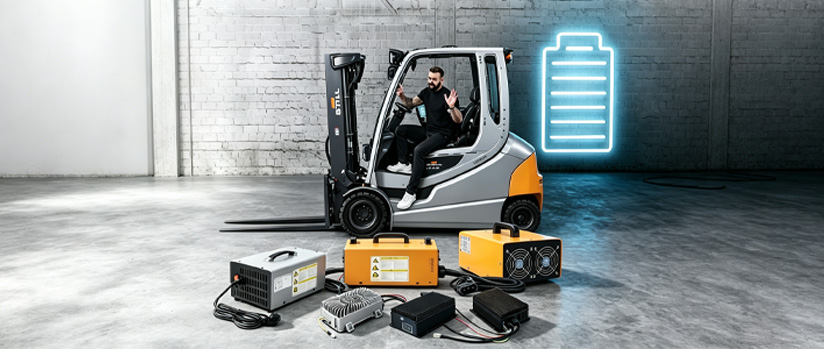
Seleccionar el correctocargador de batería Es fundamental para lograr una carga de baterías segura, eficiente y confiable. Ya sea que esté cargando baterías de montacargas, transpaletas, baterías de tracción u otras baterías industriales, usar el cargador incorrecto o seguir prácticas de carga erróneas puede acortar la vida útil de la batería, aumentar los costos operativos y generar riesgos para la seguridad.
Antes de conectar un cargador de batería, es necesario comprender varios factores importantes.
Compruebe el voltaje de la batería.
El primer paso es confirmar la tensión nominal de la batería.
Los voltajes comunes para baterías industriales incluyen:
* 12V
* 24V
* 36V
* 48V
* 72V
* 80V
El voltaje de salida del cargador debe coincidir con el voltaje de la batería. Por ejemplo, una batería de 24 V debe usarse con un cargador diseñado específicamente para un sistema de batería de 24 V.
El uso de un cargador con un voltaje incorrecto puede provocar una carga incompleta, sobrecalentamiento, daños en la batería o fallos en el cargador.
Compruebe siempre la placa de características de la batería y las especificaciones del cargador antes de cargarla.
Confirme el tipo de batería
Los distintos tipos de baterías requieren diferentes métodos de carga. Los tipos de baterías más comunes que se utilizan en equipos de manipulación de materiales incluyen:
Las baterías de tracción de plomo-ácido se utilizan ampliamente en carretillas elevadoras y transpaletas. Estas baterías suelen requerir un perfil de carga específico y una ventilación adecuada durante la carga.
Dependiendo del diseño de la batería, los métodos de carga pueden incluir:
* Carga de corriente constante
* Carga de voltaje constante
* Carga en varias etapas
* Carga de ecualización
Las baterías de litio requieren cargadores compatibles con su composición química específica y con el sistema de gestión de la batería (BMS).
Los cargadores diseñados para baterías de plomo-ácido no se pueden utilizar directamente con baterías de litio a menos que se confirme que los parámetros y perfiles de carga son totalmente compatibles.
Compruebe siempre la compatibilidad del cargador y la batería antes de usarlos.
Compruebe la corriente de salida del cargador.
La corriente de salida del cargador también es muy importante.
Por ejemplo, un cargador de 24 V/20 A y uno de 24 V/10 A cargan a velocidades diferentes. La corriente de carga adecuada depende de la capacidad de la batería, el tipo de batería, las recomendaciones del fabricante y el tiempo de carga requerido.
Si la corriente de carga no es la adecuada, pueden producirse los siguientes problemas:
* Tiempo de carga excesivamente largo
* Sobrecalentamiento de la batería
* Duración reducida de la batería
* Interrupciones en la carga
* Posibles daños a la batería
En el caso de las baterías industriales, el cargador debe seleccionarse en función de los parámetros de carga recomendados por el fabricante de la batería, en lugar de simplemente elegir el cargador con la mayor corriente de salida.
Compruebe la capacidad de la batería.
La capacidad de la batería se suele expresar en Ah (amperios-hora).
Por ejemplo:
batería de 24 V y 100 Ah
A la hora de elegir un cargador, se debe tener en cuenta el voltaje, la capacidad y el tipo de batería, así como la velocidad de carga recomendada por el fabricante.
Para las flotas de carretillas elevadoras, la capacidad de la batería es especialmente importante. Si la potencia del cargador es demasiado baja, los tiempos de carga pueden ser excesivamente largos. Si se utiliza un cargador de alta corriente de tamaño incorrecto, el rendimiento y la vida útil de la batería pueden verse afectados negativamente.
Compruebe los requisitos de alimentación de entrada.
No se centre únicamente en las especificaciones de salida del cargador; los requisitos de entrada de CA del cargador son igualmente importantes.
Antes de la instalación, confirme lo siguiente:
* Voltaje de entrada
* Frecuencia de entrada
* Monofásico o trifásico
* Corriente de entrada máxima
* Tipos de enchufes y tomas de corriente
* Requisitos de protección eléctrica
Dependiendo del diseño del cargador y del mercado en el que se utilice, las tensiones de entrada habituales para los cargadores industriales incluyen 110 V CA, 220 V, 230 V o 380 V.
Asegúrese de que la fuente de alimentación en la zona de carga cumpla con los requisitos del cargador.
Inspeccione la batería y el cargador antes de cargarlos.
Antes de conectar el cargador, realice una inspección visual básica.
Compruebe si hay problemas en los siguientes componentes:
* Cables dañados
* Conexiones sueltas
* Marcas de quemaduras
* Corrosión
* Tapones dañados
* Terminales de batería dañados
* Hinchazón o daños visibles en la batería
* Olores inusuales
* Signos de sobrecalentamiento
Si el equipo de carga está dañado, no debe utilizarse hasta que un profesional haya inspeccionado y reparado el problema.
En el caso de las baterías de plomo-ácido, compruebe también el estado de la batería y el nivel de electrolito según los requisitos de mantenimiento del fabricante.
Elija un entorno de carga adecuado.
El entorno de carga afecta directamente a la seguridad de la carga y al rendimiento de la batería.
En general, la zona de carga debe mantenerse:
* Seco
* Limpio
* Bien ventilado
* Libre de materiales inflamables innecesarios
* Mantener alejado de temperaturas elevadas y condiciones húmedas.
Las baterías de plomo-ácido pueden liberar gas hidrógeno durante la carga, por lo que una buena ventilación es muy importante.
Deben mantenerse alejados del área de carga el tabaco, las llamas abiertas, las chispas y cualquier otra fuente potencial de ignición.
Conecta el cargador correctamente
Al conectar el cargador, siga siempre las instrucciones de funcionamiento del mismo.
El procedimiento de carga típico es el siguiente:
1. Estacione la carretilla elevadora o el equipo de manipulación de materiales de forma segura.
2. Apague el equipo.
3. Inspeccione la batería y el cargador.
4. Confirme que el voltaje y el tipo de batería coincidan.
5. Conecte correctamente el conector de carga.
6. Start the charger according to the charger instructions.
7. Observe the charging status and charger indicators.
8. After charging is complete, stop the charger as specified by the charger manufacturer.
9. Safely disconnect the charger.
Do not forcibly insert or remove the charging connector, and do not modify the charging plug or wiring without professional guidance.
For lithium batteries, the BMS typically works with the charger to manage and protect the charging process.
Pay Attention to Charger Indicators and Display Information
Modern industrial battery chargers typically display charging status through LED indicators, screens, or digital interfaces.
Common status indications include:
* Power connected
* Charging in progress
* Battery fully charged
* Charging fault
* Over-temperature protection
* Over-voltage protection
* Reverse polarity protection
If the charger shows an error code or abnormal warning, do not repeatedly restart the charger without identifying the cause.
First, investigate the cause of the fault and contact a qualified technician if necessary.
Avoid Using Damaged or Unverified Compatible Chargers
A battery charger is not just a general power supply device—it is a specialized piece of charging equipment designed for specific battery parameters.
Using an incompatible charger may cause:
* Overcharging
* Undercharging
* Excessive temperatures
* Reduced battery capacity
* Shortened battery service life
* Charging failure
* Potential safety risks
If you need to purchase a replacement charger, confirm the following parameters before purchase:
Voltage, output current, battery type, charging profile, connector type, input power, and equipment application.
Perform Regular Maintenance on the Charger
Regular charger maintenance helps improve equipment reliability and reduce unexpected downtime.
The following checks are recommended on a regular basis:
* Inspect cables and connectors
* Clean cooling vents and air openings
* Check cooling fans
* Inspect terminal connections
* Check fault indicators
* Keep the charger dry
* Ensure good ventilation conditions
* Check electrical connections
For forklift fleets with high usage, regular preventive maintenance can help identify issues before charger failures affect daily operations.
Conclusion
Selecting and correctly using the right battery charger is an important part of battery management.
Before charging, always confirm:
Battery voltage, battery type, battery capacity, charger output specifications, input power, charging connector, and the charging environment.
Las prácticas de carga adecuadas no solo mejoran la eficiencia de la carga, sino que también ayudan a prolongar la vida útil de la batería, reducir los costos de mantenimiento y mejorar la confiabilidad operativa de las carretillas elevadoras y otros equipos de manipulación de materiales.
Para las empresas que gestionan flotas de carretillas elevadoras, seleccionar cargadores que se adapten a las baterías y al equipo es un elemento clave para establecer un sistema eficaz de gestión de baterías.
¿Busca cargadores de baterías para carretillas elevadoras, transpaletas y otros equipos de manipulación de materiales?Ofrecemos cargadores de baterías industriales con diversas especificaciones de voltaje, corriente y aplicación. Por favor, consúltenosCon las especificaciones de su batería y los requisitos de carga para encontrar soluciones de carga adecuadas.
Obtenga las últimas ofertas de HUAN XIN Mecánica y Eléctrica

Envíanos un correo electrónico
Correo electrónico : simon@lifttops.com
DIRECCIÓN


 IPv6 red compatible


 español
 español
 English
 français
 русский
 português
 العربية